
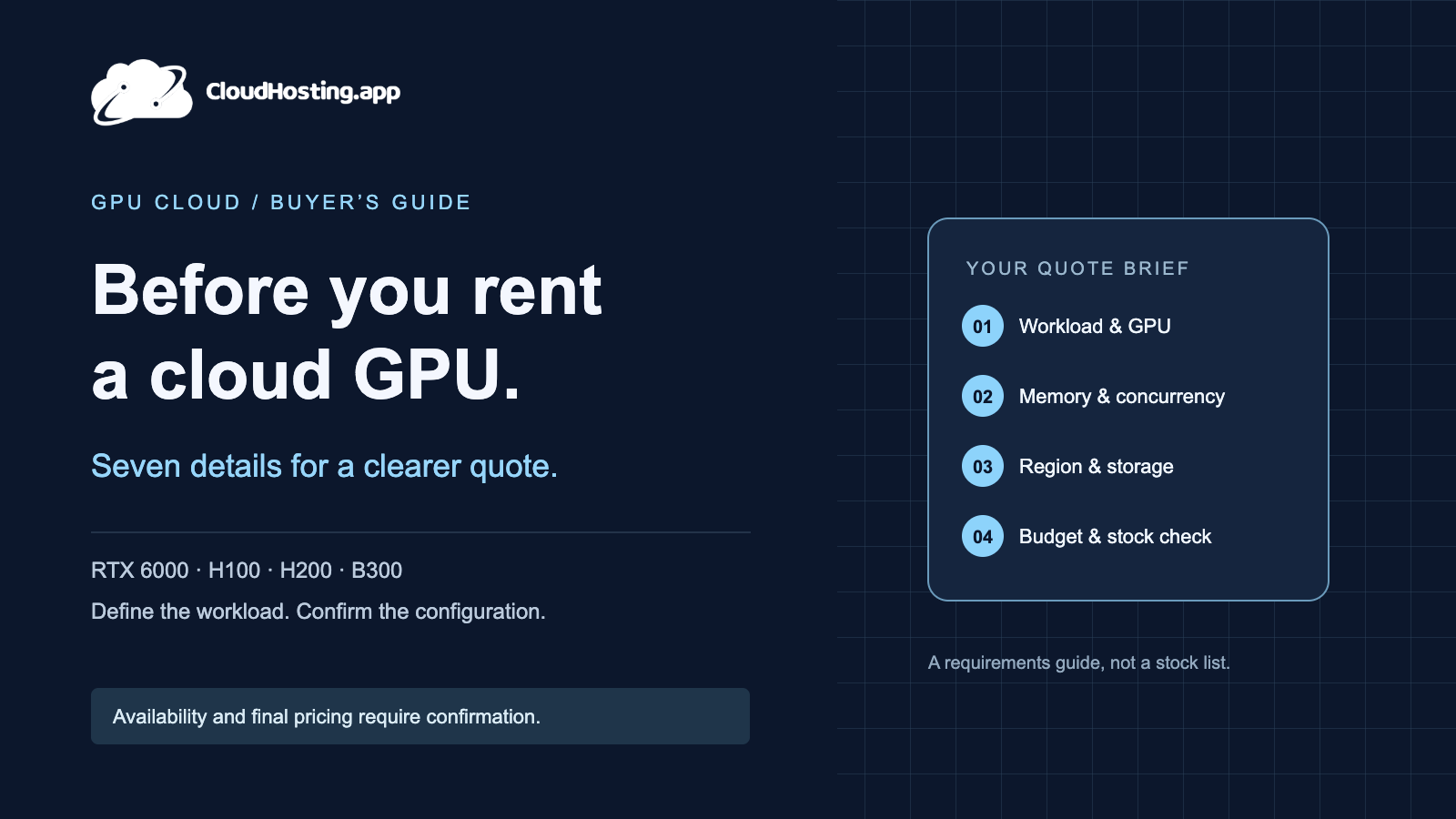
A GPU name is a useful starting point, but it is not a complete hosting requirement. Asking for “an H200 server” leaves important questions unanswered: what will run on it, how much data must fit in GPU memory, how many people will use it, and when is the capacity needed? A short workload brief helps a supplier investigate a suitable configuration and prepare a quote you can actually compare.
If you are exploring RTX 6000, H100, H200 or B300 options, gather the following seven details before requesting pricing. You do not need every answer on day one. Mark unknowns clearly so the conversation can focus on them.
1. Describe the work, not just the GPU
Start with the application and the result you need. Are you rendering scenes, developing a GPU application, serving an AI model, fine-tuning an existing model or training from scratch? Include the software or framework, model or project size, and any required operating system or driver version.
Explain how you will judge success. For an interactive service, you might care about acceptable response time at a stated number of simultaneous requests. For a batch job, you might need it to finish within a working day. These are requirements to assess, not performance promises a supplier should make from the GPU name alone.
2. Specify the exact generation and configuration
Similar product names can hide materially different hardware. In particular, the legacy Quadro RTX 6000, RTX 6000 Ada and RTX PRO 6000 Blackwell are not interchangeable names. Ask for the exact GPU model in the written quote, together with GPU count, server configuration and any relevant interconnect details.
A data-centre GPU name also does not identify the entire machine. NVIDIA lists different form factors and server options for H200. Its HGX documentation describes complete multi-GPU platform configurations, including HGX B300. Use those distinctions to ask better questions; do not assume a particular platform is included in a supplier’s offer. See the official H200 specifications and NVIDIA HGX platform details.
3. Separate GPU memory from system RAM
Write GPU memory and host system RAM on separate lines. A server advertised with 32GB of system RAM is not thereby a GPU with 32GB of VRAM. Ask the supplier to identify both quantities explicitly, rather than interpreting a single “memory” number.
Share your measured memory use if you have it. For AI work, include the model, numerical precision, context length and batch size used in that measurement. If you only have an estimate, label it as an estimate and ask how a representative test could be arranged. Avoid selecting a configuration solely because a model file appears small enough.
4. Explain concurrency and the workload pattern
One developer testing a model and a customer-facing service handling simultaneous requests have different operating requirements. State the expected number of users or jobs, typical and peak demand, and whether tasks can wait in a queue. Mention whether several applications must share the same capacity.
Describe whether you need continuous access, occasional experiments or scheduled batch work. Ask how resources are allocated and what is included in the proposed configuration. A quote should make those assumptions visible so you are not comparing different service arrangements as though they were identical.
5. Include storage, region and data movement
Estimate the space needed for model files, datasets, outputs and temporary files. Ask which storage is persistent, what happens when a machine is stopped or removed, and whether backups are included or separately arranged. Specify any recovery requirements instead of assuming that storage and backup mean the same thing.
Name your preferred region and where users or source data are located. Include expected uploads, downloads and transfers between systems. Request a breakdown of storage, network and data-transfer charges where applicable. These details help identify requirements beyond the GPU itself before you commit to a quote.
6. Give a budget, start date and expected duration
A useful enquiry includes a budget range, currency, desired start date and expected rental duration. Tell the team whether the date is flexible and whether the project may expand. This gives them a basis for discussing options without treating an indicative price as a reservation.
Compare written quotes using the same period and scope. Check the billing unit, included resources, applicable taxes, additional charges and cancellation terms. For a trial or uncertain workload, ask what options are available; do not assume that a monthly reference includes hourly billing, a free trial or a refund policy.
7. Confirm supply and the final quote before ordering
At CloudHosting.App, GPU enquiries require a stock check and a confirmed quote before an order proceeds. RTX 6000 supply is limited. H100, H200 and B300 are enquiry options, not a statement of confirmed CloudHosting inventory. A published model name or a chat conversation does not reserve capacity.
The current public reference is US$2,232 per month for one legacy Quadro RTX 6000, 8 vCPU, 32GB of system RAM and 640GB of disk space. It is a single-configuration reference, not pricing for Ada, Blackwell or a multi-GPU arrangement. Region, exact specification, availability and final charges still require confirmation. Check the CloudHosting GPU enquiry page for the approved reference and enquiry route.
A brief you can send today
Use this checklist: application or model; exact GPU preference and count; GPU memory requirement; system RAM; expected concurrency; storage; preferred region; data-transfer needs; budget; start date; and duration. Add your name and reply email, and mark anything you would like the team to help assess.
You can start with the CloudHosting AI assistant on the GPU page or email [email protected]. The conversation starts with AI assistance; staff follow-up is by email where needed, rather than a promise of an immediate live human response. If your workload may suit a standard VM, also explore the CloudHosting website and describe the application before deciding that a GPU is necessary.
Quick questions
Can I get a quote if I do not know my GPU memory requirement?
Yes—provide the application or model details and any measurements you have. State what is unknown so the team can discuss the next assessment step.
Does an enquiry guarantee stock or a deployment date?
No. Wait for the team’s explicit confirmation of availability, specification, price and provisioning arrangements before treating the enquiry as an order.
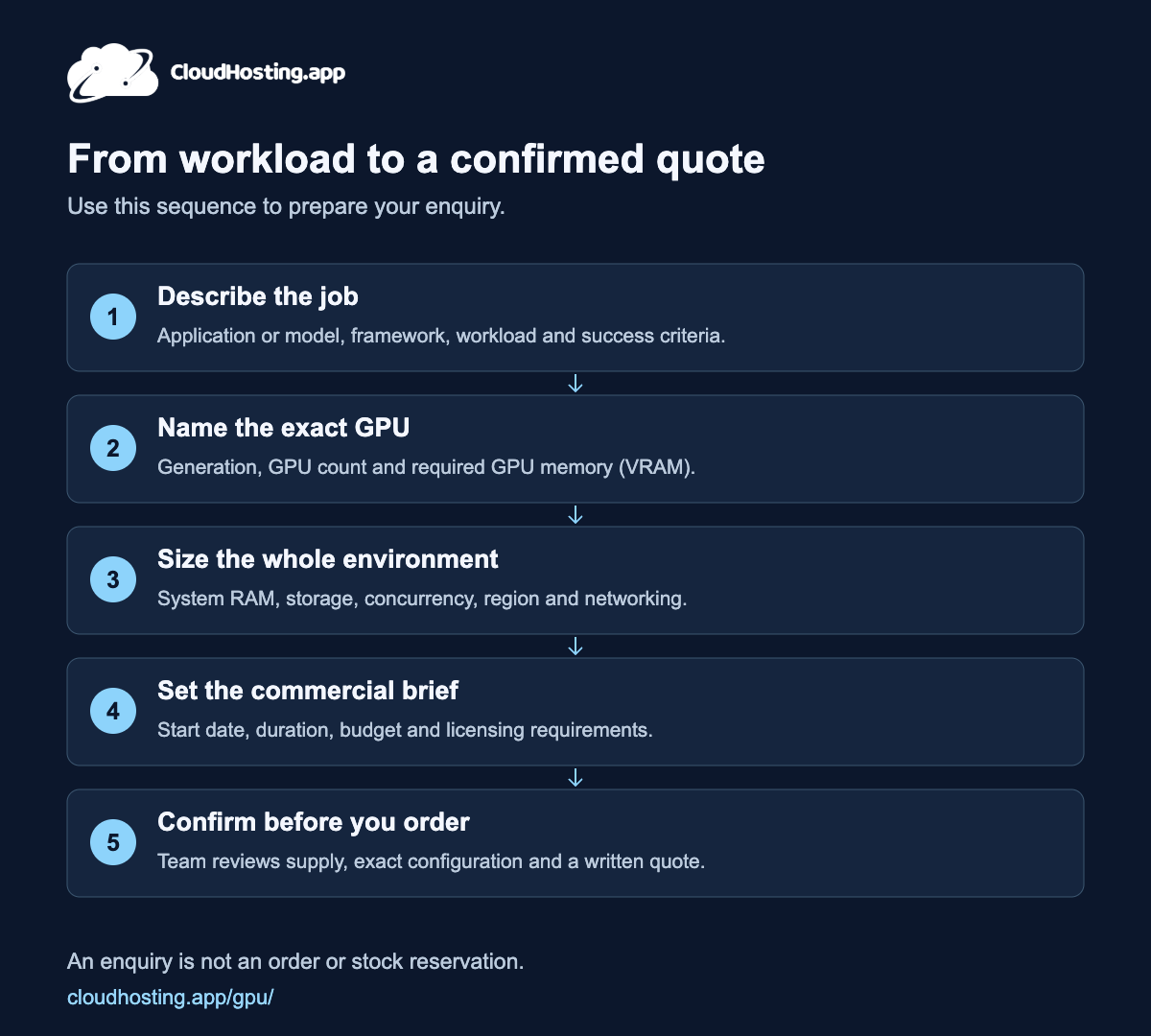
Describe the workload, name the exact GPU, size the environment, set the budget and timing, then confirm supply and the written quote before ordering.